

Bell tent wind resistance: can a bell tent withstand extreme weather?
A storm warning appears in the forecast for Thursday night. You have twenty tents on site, most of them occupied, and you have to decide what to do about it. Do you leave them standing, take some down, or move guests to other accommodation?
That decision is much easier when you know what your structures can actually take. For campsite and glamping operators, bell tent wind resistance is not a specification you read once and forget. It is the number that determines your operating procedure, your insurance position and, on nights like Thursday, your guests’ safety.
Below we look at what gives a tent its wind resistance, what “extreme weather” realistically means for canvas structures, and why a generic figure from a product page is worth less than a calculation made for your site.
What determines bell tent wind resistance?
Bell tent wind resistance comes from four things working together: the shape, the fabric, the hardware and the way the tent is anchored to the ground.
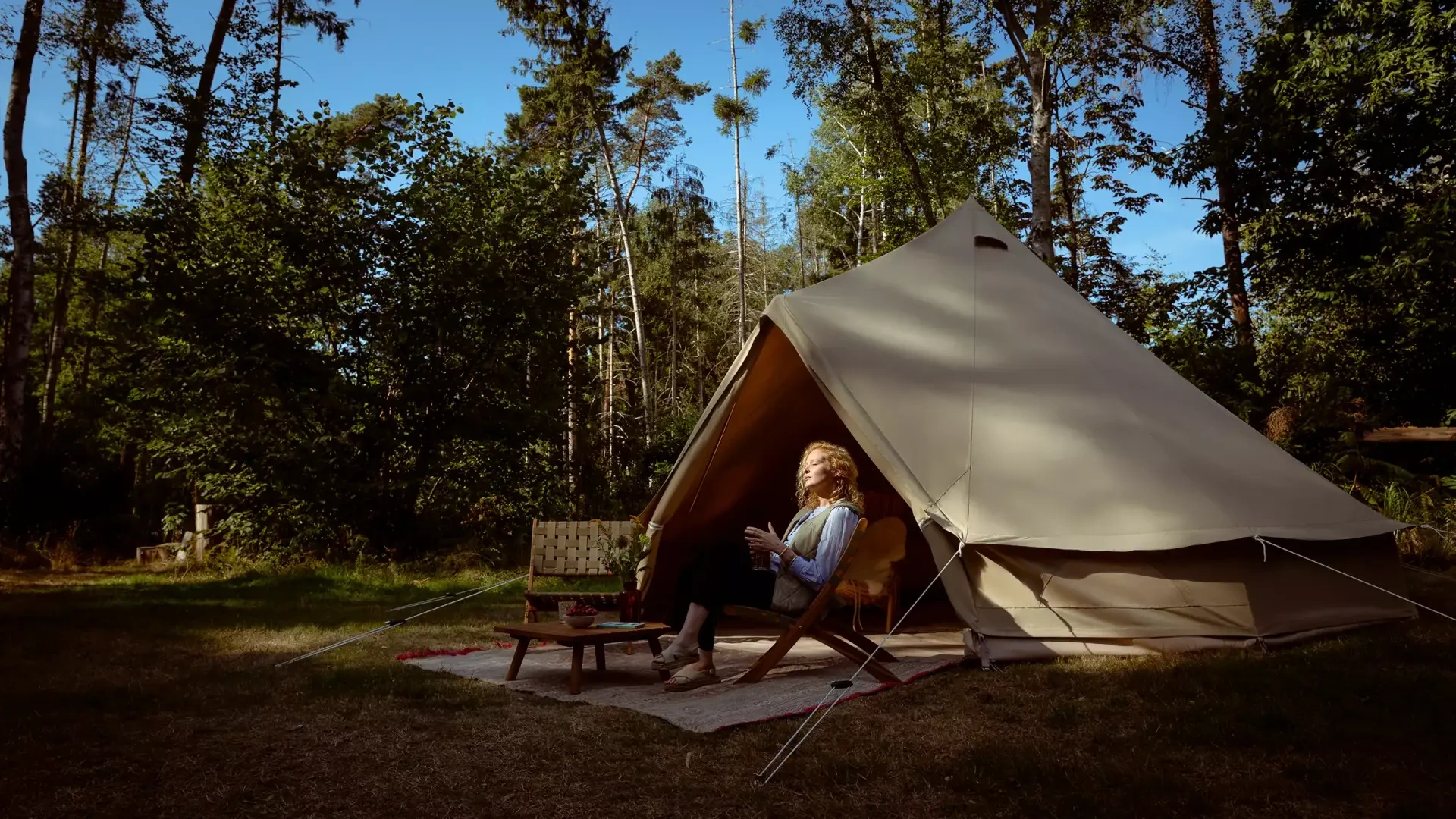
The shape does a lot of the work. A conical roof with a single central peak has no large flat surfaces for wind to push against, and the round footprint means there is no fixed windward face. Air moves around the structure instead of slamming into it. This is why the bell shape has survived as a design for as long as it has.
Fabric strength decides what happens under sustained load. OSSO® tents use 320 to 430 gr/m² poly-cotton with reinforced ripstop, which combines tensile and tearing strength. Ripstop matters more in wind than in any other condition, because a small tear in a tensioned canvas under gusting load can spread across a panel in minutes. Ripstop stops that spread at the next reinforcement thread.
Hardware is where cheaper tents give way first. YKK heavy-duty zippers and reinforced pegging points come as standard across the OSSO® range, and these are exactly the components that carry concentrated load during a storm. A zipper that splits or a pegging point that tears out turns a closed structure into an open one, and an open structure behaves very differently in wind.

Can a bell tent withstand extreme weather?
A well-engineered one handles far more than most people expect, but the honest answer is that no tent is unconditionally stormproof, and any supplier who claims otherwise is selling you a problem.
What separates a properly engineered structure is that its limits are known rather than guessed. OSSO performs structural analyses to EN, DIN and ISO standards and calculates windspeed limitations for the location where the tent will stand. That gives you a threshold you can actually work with instead of a vague reassurance.
It also helps to understand how wind damage usually starts. It rarely begins with fabric tearing in the middle of a panel. It begins at a weak point: a door left unzipped, a guy line that lost tension weeks ago, a peg that has been working loose in soft ground since the last rainfall. Wind finds the weakest element and works on it. Most storm losses are maintenance failures rather than material failures.
Wind load calculations: engineered for your location
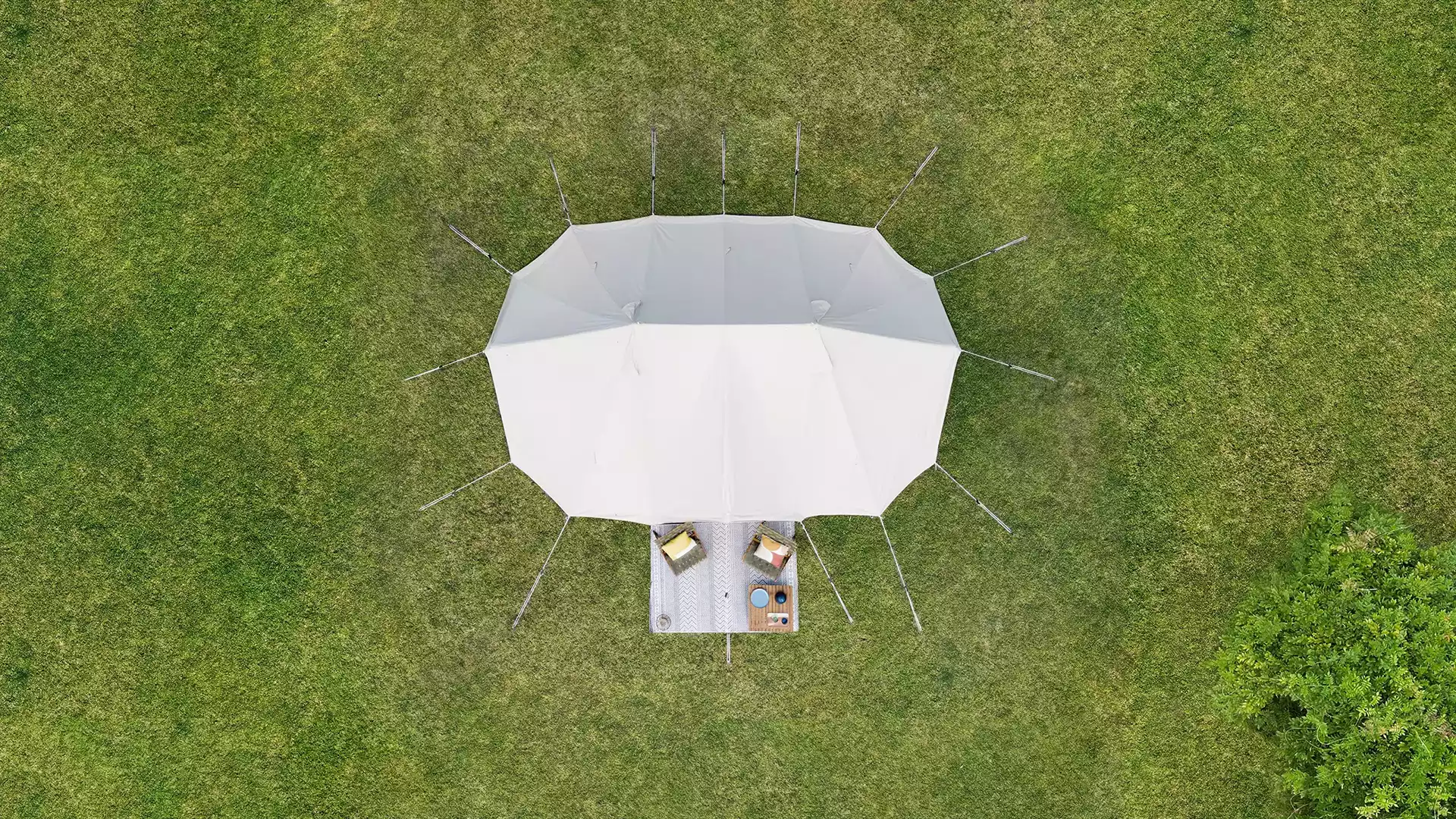
A single wind rating printed on a product page tells you less than it appears to. The same tent on an exposed coastal site, in a sheltered woodland clearing, or in a gap between two buildings that funnels gusts is three different engineering situations.
Soil type matters as much as exposure. Sandy ground holds an anchor very differently from compacted clay, and the anchoring system has to match. A structure is only as strong as its connection to the ground.
This is also where documentation becomes practical rather than theoretical. Many authorities require structural calculations for semi-permanent structures before granting permission, and insurers increasingly ask the same question after an incident. OSSO designs and engineers all tent structures in-house, which means the calculations exist and can be provided.
Anchoring, tensioning and knowing when to take a tent down
Good wind performance is maintained, not installed once. A few habits account for most of the difference.
- Match the anchoring system to the ground conditions on your site, not to what came in the box
- Keep the canvas evenly tensioned, and re-tension after storms and during dry spells when fabric relaxes
- Close all doors and window panels when wind picks up, since an open panel pressurises the tent from the inside
- Inspect guy lines, pegging points and zippers at the start of every season and after severe weather
- Use natural shelter where you can, and avoid siting tents in gaps that accelerate wind between buildings or treelines
Set a wind speed threshold at which tents come down or guests are relocated, write it into your procedure, and make sure seasonal staff know it. The decision is far easier when it has already been made in advance.
Built for all conditions
OSSO tests every structure in factories, in laboratories and in the field, because those are the conditions the tents have to perform in. Sourcing directly from the manufacturer and controlling the full production chain is what allows us to guarantee the same quality across every tent we deliver.
Want to know what your site can handle and which model suits it? Get in touch and we will run through it with you.
Contact usOSSO® Outdoor Fabrics
Developed by our in-house development and innovation team, OSSO® Outdoor Fabrics have the perfect balance between fabric weight and durability.
Discover
